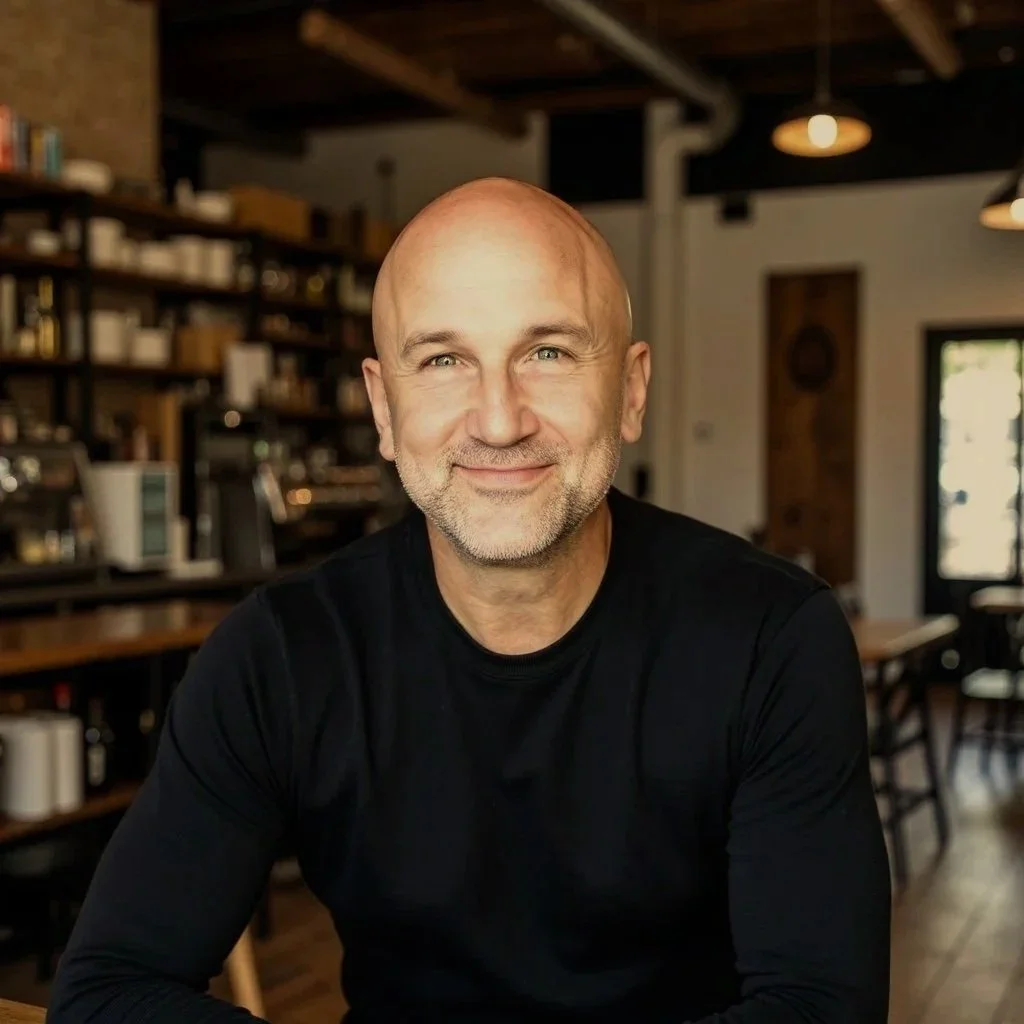
About Troy Richmond Dixon
The first job Troy Richmond Dixon ever took purely for the money was the overnight cleaning shift at a slaughterhouse in Jackson, Michigan. He worked a station the crew called the blood pit - a cement trough twenty yards long that had to be hosed down, scrubbed, and cleared by USDA inspectors before the day shift arrived. He was in his early twenties, out of college, out of ideas, and certain of only one thing: there had to be something better than this, somewhere.
He found it a year later, washing dishes at a small restaurant on the California coast.
What followed was twenty-five years of not skipping a rung. He waited tables at the Ojai Valley Inn & Spa and became a restaurant manager there. He ran Bluehour in Portland, one of the rooms that defined that city's dining scene, as general manager. Then a recruiter called about a director of food and beverage job at a downtown Marriott that would double his salary overnight, and he took it - a decision he spent the next several years learning the true price of. He found his way back through the Kimpton RiverPlace, four and a half years as general manager of Ruth's Chris, and a return to hotels as director of food and beverage at The Porter.
In January of 2020 he took a new job as director of operations for Hilton in Portland. Ten weeks later the industry shut down. He spent that year holding a hotel together in a city that stayed closed longer than most, and by November he had moved two thousand miles to Memphis to start over as director of operations for Hyatt Centric, then as general manager of the Central Station Hotel. He ran the Graduate Hotel in Oxford, Mississippi, and is today area general manager for Schulte Hospitality Group, overseeing the Embassy Suites and Hampton Inn in East Memphis. He is the founder of the Spirit of Service Leadership Group.
Dishwasher, server, restaurant manager, general manager, food and beverage director, operations director, hotel general manager. He has held nearly every job there is to hold in a restaurant or a hotel, in that order, without skipping any of them. He has also worked nearly every kind of property: a destination resort, a chef-driven independent, a downtown convention hotel, boutiques, a steakhouse, a college-town hotel, and a Hampton Inn. That range is the argument. If these ideas only worked at a luxury resort, they would be a luxury resort's ideas.
It is also the reason he writes about service the way he does. He isn't describing the floor from a corner office. He spent twenty years standing on it.
The idea that became his first book arrived in the least dramatic setting imaginable: a pre-shift meeting at Ruth's Chris, where a longtime server announced she had passed the bar exam and added, "Thank God I won't have to be in the service industry anymore."
She meant nothing by it. She was leaving the restaurant, not insulting it. But the sentence exposed an assumption Troy had spent his entire career inside without ever naming - that service is something you escape from rather than something you choose. It led him to the argument he has been making ever since: that everyone is already in the service industry. That every job, every task, every order filled ends up in someone else's hands. That the question was never whether you serve, but what service you want to provide, and to whom.
Troy's grandfather never used the word hospitality. But every Thanksgiving he would put his hand over his grandson's on the handle of the same knife and teach him the angle, the rhythm, and the patience the work required - and that you celebrate when the job is done, not before.
That knife is still in the drawer. Troy is writing the book that names what was being passed down.
He writes Notes from the Floor and lives in Memphis.